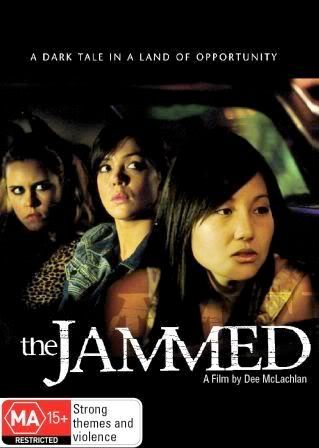
Tuesday, January 29, 2008

THE JAMMED NOMINATED FOR FOUR FILM CRITICS CIRCLE OF AUSTRALIA AWARDS


The Film Critics Circle of Australia is the national body of professional film critics in Australia. The FCCA recognises outstanding achievement in Australian film through the FCCA Annual Awards.


The Jammed received four nominations:


Best Film - Producers: Sally Ayre-Smith, Andrea Buck, Dee McLachlan


Best Director - Dee McLachlan


Best Script - Dee McLachlan


Best Supporting Actress- Saskia Burmeister


The awards are announced in Sydney February 1st, for more information or tickets head to:


Thursday, January 17, 2008

INTERESTING SCRIPT ARTICLE IN THE AUSTRALIAN MENTIONING THE JAMMED...

Scripts fail to tell the whole story
Lynden Barber January 02, 2008

Thanks to the introduction of a 40 per cent tax offset to producers, many players are confident that production levels will pick up and the industry can dig itself out of the slough of despond with a few overdue international hits.
Actor Hugh Jackman, who is producing Australian films through his company, Seed Productions, summarised the cautiously buoyant mood when he told The Australian: "I would have thought for the next two or three years it's an optimistic time for the industry. Let's pray it's going to be good."
Prayer will not be enough, however. The most common complaint about Australian films is that their scripts are undercooked and need more development money
Talk to some of the top screenwriting experts and it becomes obvious that the problem goes deeper than a mere lack of money for writers to polish their work. In their view the industry suffers from deep-rooted cultural problems that consistently militate against the possibility of compelling scripts emerging at regular intervals.
And they warn that if these problems aren't seriously addressed, then Australia's poor standard of screenwriting is unlikely to improve, no matter how much money is thrown at it, and the audience share for our films will remain frustratingly low.
These critics are not casual bystanders. They're screenwriting professionals who have worked at the highest levels in filmmaking and education. They are exasperated at the amateurism that engulfs so much local screenwriting: not just from would-be filmmakers but frequently from writers whose films go into production and are commercially released.
Joan Sauers has been an adviser at all four SPARK screenwriting workshops held annually by the Australian Film Commission, and taken part in six European workshops. In the late 1970s and early '80s she worked as a reader and script editor for leading US filmmakers Barry Levinson and Francis Ford Coppola. She is about to join the AFC as a project officer.
Former script editor and teacher Duncan Thompson is the artistic director of Aurora (the annual screenwriting workshops held by the NSW Film and Television Office) and is head of the International Film School Sydney, where he is also head of screenwriting.
Billy Marshall Stoneking is a veteran teacher, script editor and story consultant who has held or is planning screenwriting workshops for institutions including the Australian Film, Television and Radio School, IFSS and Sydney Film School. While all three script experts have some differences in emphasis, they display a remarkable unanimity on the seriousness of the creative challenges facing the Australian film industry. The chief problems are:
* A cultural blind spot regarding drama, because the Australian way is to avoid conflict.
* An alarming lack of knowledge about the craft of screenwriting but no willingness to admit this and to learn.
* Widespread ignorance of screen classics, and no understanding of the ways in which these great films work.
* Training is inadequate or, as Thompson puts it, "absolutely crap, atrocious".
In addition, there's a kneejerk anti-Hollywood attitude, in which basic notions of film structure are viewed as a form of US cultural imperialism, leading to the baby (a strong sense of dramatic structure) being thrown out with the bathwater. According to Sauers, "there's sort of this idea that 'it's either Hollywood, or it's what we do' -- and what we do isn't strong enough".
Most Australian professional screenwriters have spent time writing for television soaps Neighbours and Home and Away, where they've learned bad habits. For example: their characters talk about how they're feeling or what they're doing instead of just getting on with it. "I've seen this all the time in Australian cinema, where characters discuss the scene they're in," says Thompson. "I think it's the major flaw in Australian writing."
The myth of originality holds undue sway. The story doesn't have to be original; more crucial is the way the story is told. Stoneking recalls his incredulity at taking part in a workshop in which a feature script, which had already attracted $20,000 in public development money, had as its protagonist a puddle.
"It didn't speak, it didn't have a face, it didn't have any interior monologue or thought process, no arms or legs, and it moved around the floor and it was thoroughly undramatic," he says. "And when I queried the project officer ... the reply was, 'We'd never had one of those before'. It went completely against the idea of what character-based storytelling is about and it had absolutely no dramatic grammar whatsoever."
Characterisation tends to be lacking. The screenwriters don't get deep inside their characters in the way necessary to bring them alive and make them interesting and unpredictable. Lead characters in Australian films, especially the males, tend to be passive. And by the end of the film there's been little character transformation.
Whether in drama or comedy, the action suffers from a lack of motivation. Things happen at the whim of the writer, without showing the relationship between cause and effect. Effective screenplays create problems for characters, that they must strive to overcome.
There's also too little dramatic incident, and the crucial point from which the story takes off, called the inciting incident, often happens so late that viewers are already checking their watches.
Sauers says there's nothing wrong with presenting depressing subject matter if it's presented in an engaging way, citing the Danish film Wilbur Wants to Kill Himself. But Australian films too often make downbeat subject matter depressing to watch. Many Australian films, she adds, suffer from emotional and dramatic monotony that makes them seem like short films stretched thin over 90 minutes.
So who are some of the more recent offenders? Sauers and Stoneking are both critical of Romulus, My Father, adapted by Nick Drake from Raimond Gaita's memoir. Directed by Richard Roxburgh, it won best film at the Australian Film Institute Awards last month.
"It's not a dramatic film," says Stoneking. "There's so much about it that you want to like but it just never quite gets itself started, the energy doesn't really build." Sauers says Matthew Saville's Noise had script problems, and Stoneking calls Lucky Miles "a terrible film" because "it plays up to a lot of the baser instincts of the Australian mentality: that foreigners are buffoons at best".
Sauers approvingly cites a 2004 paper by producer Peter Sainsbury, in which he excoriates the standard of Australian screenwriting and names Japanese Story and Walking on Water as examples of films whose scripts should have been stronger. "They're interesting films, based on interesting premises," she says, "but essentially the characters are reacting to situations that have been thrust upon them."
So are there any local examples to learn from? Thompson says The Black Balloon (to be released in March from first-time writers Elissa Down and Jimmy Jack) is "brilliant". Stoneking says Ten Canoes is "one of the great world movies" and he admires Kenny ("there is a great transformative journey for a character").
Sauers nominates The Jammed, Saw (a US film but written and directed by Australians), Wolf Creek and Muriel's Wedding as films constructed around strong dramatic storytelling principles, including putting their protagonists through hell. It can hardly be coincidence that the above were all popular with audiences and most with critics too.
So what of the future? Mentoring initiatives such as Aurora and SPARK can help. Sauers says we need to spend more time educating producers and more closely mentoring writers throughout the creative process. For Stoneking the hope lies in building creative links with the corporate sector, which is becoming interested in storytelling workshops. But all agree the problem will not be solved by throwing more public money at extra script drafts when the blueprints are dramatically unsound to begin with.

From The Australian: http://www.theaustralian.news.com.au/story/0,25197,22995224-16955,00.html

Monday, January 14, 2008

DAVID STRATTON'S CINEMA WRAP UP FOR 2007 IN THE AUSTRALIAN


Fine thrillers stole the show
David Stratton December 26, 2007


BY my count, 255 films were released in Australian cinemas during 2007 and I saw just about all of them.This number doesn't include the Bollywood and Asian films that opened, without previews for the mainstream press, in marginal capital-city theatres. The vast majority of films released were American and the quality, not surprisingly, varied from the dire (Saw IV, I Now Pronounce You Chuck and Larry) to the splendid, 10 of which are listed below.
It was a moderately good year for Australian cinema, even though box-office returns were mostly very disappointing. The high-profile films were flawed in one way or another, and my choice for best Australian film of the year is Dee McLachlan's The Jammed, a beautifully written and acted thriller in which an ordinary young woman discovers the evil underworld of sex slavery is alive and thriving in her city.
McLachlan fought a long, hard battle to fund the film (the leading funding bodies rejected it) and to release it (there was initial reluctance on the part of all the distributors). It was even, mysteriously, rejected by the Melbourne International Film Festival. But after screening at the Sydney and Brisbane festivals it caught the attention of public and critics alike and enjoyed a modest, but encouragingly successful, commercial run.
Sadly, the Australian Film Institute deemed the best Australian film of the year ineligible for the AFI Awards because of a technicality, which could surely have been overcome with a modicum of goodwill. Would it have displaced Romulus, My Father as the winner? Who knows, but no other locally made film of the year succeeded so completely in what it set out to do. McLachlan had to be content with winning the IF Award for best film.


Very Special thanks to David Stratton for finding and supporting The Jammed in 2007, Mr Stratton is in a word, Incredible!


AND THE AWARD GOES TO....


Jim Schembri presents the Schembri Film Awards for Cinematic Excellence in 2007.


The I Can Do More Than Open Blockbusters Award goes to:


Will Smith for The Pursuit of Happyness, a touching, personal drama that drew in a sizeable chunk of his fanbase.


■The … And We Thought This Franchise Was Dead Award goes to: Die Hard 4.0 for reviving an action movie franchise that had been comatose for 12 years with a kick-ass, steroid-fed action spectacle that cleared the cynicism from the sinuses.


■The We Wish This Franchise Was Dead Award goes to: the third instalments of Pirates, Ocean's and Shrek. Enough already.


■The Most Realistic Action Hero Award goes to: Matt Damon, doing his best running-and-jumping work in The Bourne Ultimatum.


■The Comic Brilliance Ignored Award goes to: Dr Plonk. Rolf de Heer's masterful monochromatic silent comedy was fast, funny, clever and seen by practically nobody.


■The Best Period Film Award goes to: This is England, for evoking the evil allure of racism in 1980s Britain with such frightening authenticity.


■The Best Straight-friendly Gay Film Award goes to: 300. Something for everybody with abs aplenty amid crowd-pleasing action. Runner Up: I Now Pronounce you Chuck and Larry. Wake up, Gay Rights lobby. Having Adam Sandler on your side is a good thing, not a bad thing.


The Come From Behind Award goes to: The Jammed. By far the best Australian film of the year, this compelling, micro-budget drama about the Melbourne sex-slave trade was destined for a straight-to-DVD release before being discovered by audiences who carried it to victory at the IF awards.


And the list goes on.. big shout out to Jim Schembri from The Jammed team, THANK YOU for all of your support!!!Check out his blog here: http://blogs.theage.com.au/schembri/

Tuesday, December 18, 2007

THE AUSTRALIAN MAGAZINE NAMES DEE MCLACHLAN IN IT'S 2007 A-LIST...


Dee McLachlan in The Australian's A List of 2007.

Click on image and article to Enlarge.

Photo: Andy Baker

THE JAMMED'S WRITER/DIRECTOR DEE MCLACHLAN IN MELBOURNE'S MOST INFLUENTIAL LIST....


Click to enlarge and read article in The Age's Melbourne Magazine listing Dee Mclachlan as one of Melbourne'e most influential people.

Sunday, December 2, 2007

THE AFI DEBATE IN THE AUSTRALIAN....

Out of the picture
Michael Bodey | December 01, 2007

GEOFFREY Rush once told of the time he was walking along Melbourne's Flemington Road after horseriding training for his role in the European film Les Miserables.
He'd just won a Golden Globe award for his performance in Shine and was weeks away from winning his first Oscar.

"I saw this truck belting down the road and there was this look of recognition from the driver, who yelled out: 'Hey Geoff, good luck with the Logies!'

"I treasure that as a divine moment."

It's a cautionary tale ahead of this week's Australian Film Institute Awards, as the country's petty cultural divide between the film and television sectors reopens.

The AFI Awards will be boycotted by the leading nominee in the TV categories, ABCTV, and will be without a number of high-profile nominees who either didn't want to enter, missed the inexplicably revised entry dates or didn't qualify, including the film recently adjudged best of the year at the Inside Film Awards, The Jammed.

"This film has been made outside of the film industry and been outside of the box in many ways," says its producer, Andrea Buck.

"It didn't seem to fit the grooves of many of the powers in the film industry, so it's a really, really big disappointment for us that it is just a bureaucratic thing that means we can't be included."

While there are inevitable anomalies and gripes surrounding any awards ceremony, this year's AFI Awards appear to have reached breaking point. The Jammed's exclusion is the least of its worries.

ABC TV's decision to boycott the ceremony has been widely supported by the industry. Television producers feel the AFI brought TV into the fold in 1986 begrudgingly in order to broaden its public profile and attract TV coverage.

"I was really encouraged by the flood of emails, comments and calls I've had from television producers in particular supporting the ABC's position, saying it's about time one of the broadcasters stood up," says the ABC's director of television Kim Dalton.

The ABC's concerns stemmed not from the institute's decision to spread the awards over two nights, only one of which would be broadcast, but from the "insensitive" moving of most TV categories to the first night.

What was formerly the Craft Awards and is now dubbed the AFI Industry Awards will take place on December 5, and the AFI Awards dinner will be broadcast on the Nine Network on Thursday, December 6, a non-ratings period.

While the split over two nights had been reluctantly accepted during its first two years, a class distinction has been instituted this year, with only a handful of TV categories being announced on the broadcast night.

"I suppose the icing on the cake was the insensitivity in which they dealt with the key creative teams," Dalton says.

The two most popular Australian TV programs of 2007, Kath & Kim and Thank God You're Here, did not enter the AFI Awards and the most popular new comedy, the ABC hit Summer Heights High, did not qualify, as applications closed on May 25 for eligible programs that were "produced for television and broadcast in Australia for the first time between October 19, 2006 (and) September 26, 2007".

The final application date, more than six months before awards are held in December, is incredibly restrictive and far earlier than in the case of any comparable awards ceremony anywhere in the world.

Indeed, this year the application date was moved forward, which caught some unawares, including producer Nick Murray, whose Jigsaw Entertainment wished to enter the previous award-winning comedy series Stupid Stupid Man.

"We tried to enter two weeks before the awards normally close but we were three weeks late," he says, noting the AFI sent out emails only to producers for whom it had email addresses on its database.

The AFI told the producers of The Jammed and Stupid Stupid Man that no exceptions would be made to the cut-off date. Yet three years ago, the AFI implored one high-rating TV program to enter the awards when it failed to do so. Apparently, the ceremony needed the audience the program's stars would bring.

To read the rest of the article head to: http://www.theaustralian.news.com.au/story/0,25197,22850586-16947,00.html